A Change in Plan(ner)s

I didn’t get to travel much when I was young so Kenn and I wanted to make sure our boys had a chance to see a little more of the world. We couldn’t afford to take them on cruises or jet off to international locations but we could at least get them out of the house and introduce them to the sort of places that we love. (They would probably say we took them hiking far too many times, LOL.)

Time and money management were always important on our trips so I planned everything down to the nth degree. I researched the locations we were planning to visit, booked the hotel rooms/cabins, and planned out our activities for each day. Looking back, I may have occasionally over-planned, but it was a labor of love.

Keeping up with details, planning, and organizing are just a part of me and have served me well both at home and at work. However, I think the last four years of my day job sort of burned me out. I enjoyed what I did but it required an extreme amount of organization; my days were ruled by a schedule that was usually booked at least a week in advance. Now that I’m retired, I’m enjoying having flexible days without having to account for every minute of my time.

Somehow, without our even discussing it, Kenn came to my rescue because he is now the one doing most of the planning for our trips. We decide together where we are planning to go and when and he handles making the reservations. I’m still the money manager but I’m happy not having to deal with all of the details.

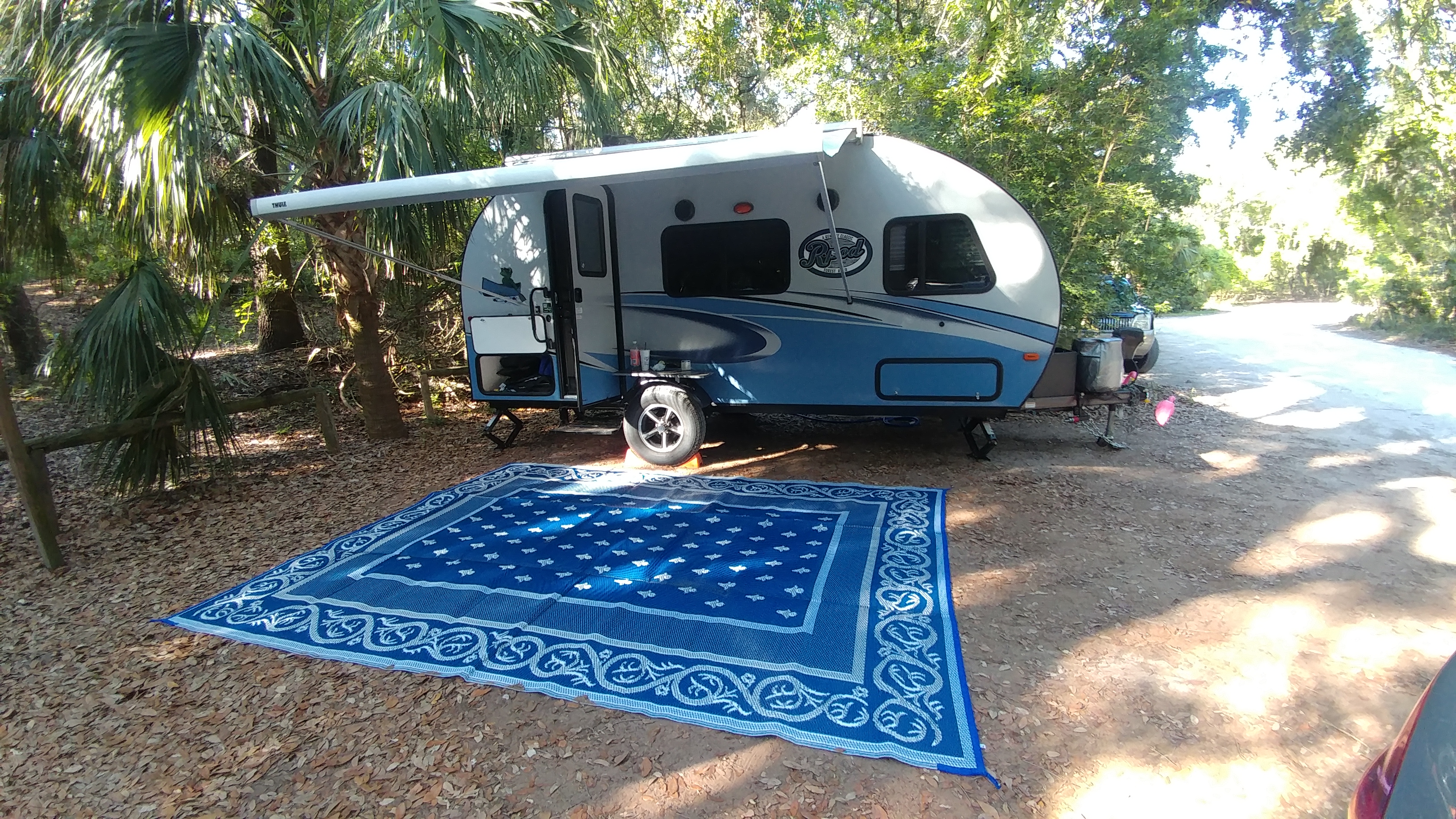
We cancelled our road trip plans last year due to the pandemic but this year we are fully vaccinated and ready to hit the road. We’ll be taking a trip up the east coast this fall. This will be our first time traveling long distances with our travel trailer so I’m sure we’ll be learning many lessons along the way which, of course, I’ll share here. 🙂 As proof of his new role as Chief Trip Organizer, we already have reservations at a campground in Maine. Go, Kenn!

Until next time, happy trails!
Review: Fort Clinch State Park

Fort Clinch State Park is located at Fernandina Beach, Florida. (Fernandina Beach is located on Amelia Island, a barrier island off the eastern coast of Florida.) Fernandina Beach is a special place to Kenn; he and his family spent a week there every summer when he was growing up. I learned to love it as well when we took our sons a few times over the years. (Well, as much as I love any beach.) When we visited with our boys in tow we stayed in a hotel or rented a house. Once we became empty nesters and bought a travel trailer, we decided to visit Fort Clinch State Park; it became an instant favorite.

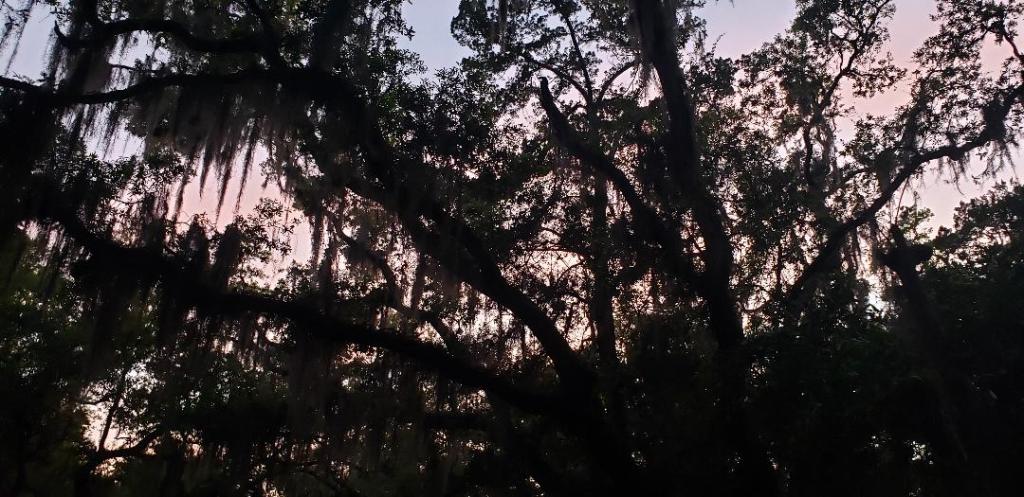
Fort Clinch has two campgrounds: riverside and beach-side. We prefer the riverside. The riverside sites are well shaded by old growth trees dripping with Spanish moss. While there are a few palm trees scattered around the beach-side sites, none of them are actually shaded. The bath houses at both campgrounds are clean and well-maintained and there are washers and dryers available for use.

Sunset at the riverside campground

Fort Clinch is perfect for both nature and history lovers. Nature is everywhere and the beach is an easy walk from the campground as is Fort Clinch, which dates back to the Civil War. If you are a fossil-hunter like me, the beaches around Fort Clinch are great for hunting shark’s teeth – especially if you happen to be there just after the channel has been dredged. (All of the teeth, etc. pictured in my recent post about fossiling were found at Fernandina Beach.)

There are a couple of things to keep in mind when planning a stay at Fort Clinch State Park. The first is that it is hard to get reservations at this park. Reservations open up eleven months in advance and are gone almost immediately. Our last trip to Fort Clinch took place in April 2021. It took Kenn a couple of weeks of stalking the reservation site in May 2020 to get our reservations. Second is that you need to be prepared to take your time when entering (and exiting) the park while towing. The entrance road is covered by a beautiful canopy of old growth live oaks; the bigger your rig, the more “exciting” your drive may be. However, if you take your time (and occasionally drive in the middle of the road) you’ll be fine.

Sign at the entrance to the park

We’ve talked about making a trip to Fort Clinch every year but the verdict is still out. We love the park but there are just so many places to see!

Until next time, happy trails!

Review: Moccasin Creek State Park

This is the first of the reviews I will post regarding the various campgrounds/parks we visit. I’m not going be rewarding a star rating or anything like that. I’m just going to post my thoughts on the park, pros/cons, etc.

Moccasin Creek State Park is located in the mountains of Rabun county in north Georgia. The park is bordered on three sides by Hwy 197 and on the fourth by Lake Burton. First impressions are important and, when we entered the park, my first thought was “Wow. This place is small. I don’t like it.” The website lists the size of the park as 32 acres; I’m not sure what is included in that acreage but the actual area for campsites is nowhere near that large. Even so, the park features 53 campsites.

Small “falls” on the stream in the park

One of the most important things to me when camping is the layout of the campsites. Are they shaded? (Shade is an important consideration here in the South – especially in the summer.) Are they on top of each other or is there a little space in between sites? Our campsite was on the outer loop for which I was thankful. I don’t like feeling crowded, especially when camping. If we had been in the inner section, I would have probably been ready to leave the next day. Being on the outer loop meant that our campsite backed up to the road but that wasn’t a problem; Hwy 197 is a two lane “country” road and is hardly a beehive of activity.

In spite of my initial dislike of the park, it grew on me a little over our visit. Moccasin Creek is a really pretty park. A small stream flows down one side of the park and there are swings and benches scattered around where you can sit and commune with nature. Normally, it would have been possible to rent a kayak, canoe, or paddleboard; however, this is 2020 and rentals were not available due to COVID restrictions. Fortunately, no special equipment is needed to view Hemlock Falls and it’s an easy hike from the park.

Hemlock Falls

If you get twitchy without easy access to cell service at all times, brace yourselves. Verizon is our service provider and our signal strength was virtually non-existent at the park. However, there are a few towns within easy driving distance where signal strength is better.

Overall, while pretty enough, Moccasin Creek is not a park we plan to revisit.

Have you been to Moccasin Creek? If so, what did you think?

The Evolution of a Couple’s Camper – Part 2

In my last post I introduced you to Hope, an RPOD 177 and our first travel trailer. As we were in the thick of elder care, our ability to travel was limited but we did make trips as our schedule allowed – mostly to state parks within a 3-4 hour drive from home. We were complete newbies but with each trip we became a little more comfortable with the process of towing, setting up, etc. Backing the camper? Not so much. Backing a travel trailer into a camp site is a test for even the strongest of marriages. (I’m only sort of joking.)

We knew going in that Hope would not be our “forever” camper. We knew that as we age and get to travel more and for longer periods of time that we would want to upgrade to something a little larger. So, we used our time with Hope to determine what changes/improvements we would like to have on our next travel trailer.

First on the list was more storage. It’s a given that storage in a small travel trailer is going to be at a premium. But, all travel trailers are not created equal. It’s worth taking the time to check out models made by different manufacturers before making your final selection. Hope had a full pass-through on the exterior for storage of chocks, chairs, etc. but interior storage was pretty much non-existent. Trips more than 2-3 days in length required a lot of creativity and more than a little frustration for the storage of food and clothing.

Second was a dry bath. The wet bath on a 177 is tiny and there is a pretty healthy step up/down to get in and out. My husband was already starting to have problems with his knees so we knew there was a good chance that that step was going to cause problems over time. Yes, most campgrounds have bath houses but if you are boondocking where there are no facilities (or if the campground facilities are just nasty) a decent bath is nice to have.

In late 2016 my husband said that he thought we should check out the RPOD 180 – it was slightly larger and had a dry bath. So, we made the trek to one of our local dealers to do a walk-through and it was basically love at first sight. The 180 was a couple of feet longer than our 177 and had more storage for both food and clothes. It also had a three piece dry bath (vanity/sink, toilet, and an actual shower). So, we put the 180 on our wish list. Several months later when the price dropped prior to the release of the 2018 models we took the plunge. My only regret is that we decided to trade-in our 177 instead of selling it outright. Yes, the trade-in was a lot less hassle but we would have gotten much more for it had we sold it. Ah, hindsight!

Meet our RPOD 180, eventually named Gypsy. (It was a lot harder to name this one.)

RPOD 2017 floor plan image from RVUSA.com via Google

In addition to the increased storage and dry bath, there were a few other improvements as well. The interior colors of our 180 were much lighter than those on our 177. Entering the 177 was like entering a cave. The walls, floors, and upholstery were all varying shades of brown. Even with all of the blinds open and lights on it was just dark. Gypsy also had awning as opposed to the “rdome” that came with Hope. A lot of Podders love the rdome because it adds a screened-in room to the exterior of the pod. However, the set-up/tear-down process is not for the faint of heart. The push-button awning is more our style. I was also excited about the blue exterior on Gypsy. (The older models were green, which is my least favorite color.)

The 180 was a couple of feet longer than our 177 and weighed about 400 pounds more which meant we could no longer tow with our Toyota Highlander. Fortunately, my husband had replaced his clunker truck with a 2006 Toyota Tacoma which had more than enough power to tow the 180.

Of course, our adventures don’t end there. Stay tuned for Part 3!

The Evolution of a Couple’s Camper – Part 1

20140723_183648

My husband and I come from vastly different backgrounds. One of the biggest differences was that his family traveled, mine didn’t. His parents owned an RV and would hit the road for two or three weeks every summer and my husband frequently expressed a desire to do the same. Initially, I wasn’t sold on the plan. In my mind, the cost of an RV plus the insurance, etc. would more than offset any savings achieved. But, over time, I gradually came around to his way of thinking and we began dreaming of “someday” owning a small travel trailer – the RPOD by Forest River seemed a perfect fit for our needs.

Our someday arrived much earlier than expected when we found an RPOD 177 for sale by owner in the parking lot of a local pawn shop in 2014. After much discussion (spontaneity is not a strong point for either of us) we contacted the owner and set up a meeting to tour the camper. Honestly, it was almost too good to be true – it was the travel trailer version of the little old lady who only drove it on Sundays. The owner, an elderly man, bought the camper for he and his wife to stay in on his trips to his hunting club. However, his wife developed Alzheimer’s and passed away. No longer having a need for the trailer, he decided to sell – they had never even used it. It still wrenches my heart when I think about it. We agreed to a price and the camper became ours.

RPOD 177 Floor Plan. Image from RVUSA.com via Google

The 177 was the perfect size for two people with all of the necessities and none of the frills. And, for those rare occasions in which we might have guests, the dinette converted to an extra bed. What more could we need? Its small size also meant we could tow it with our existing Toyota Highlander – a definite plus as neither of us was interested in upgrading to a larger tow vehicle.

Once the purchase was complete, the next step was to name our camper. (Yes, we name our vehicles.) We named her Hope. At that point in our lives we were overwhelmed with full-time jobs and taking care of three elderly parents. We knew we might not get to travel much for a while but we needed some hope in our lives and Hope the RPOD became the physical embodiment of that much needed trait. She was quite forgiving of our newbie mistakes as we began our forays into the camping world. (We bounced the trailer off the hitch THREE times before learning to quadruple-check to make sure the hitch was properly secured.)

We also discovered a wonderful community of other RPOD owners when we joined the R-Pod Owners Facebook group. The group members have been a tremendous source of information and encouragement. If you own an RPOD and aren’t a member of the group, I highly encourage you to join ASAP. Oh, and we also learned that naming your RPOD is a Really Big Deal not to be taken lightly.

Stay tuned for The Evolution of a Couple’s Camper – Part 2.