Review: Fall Creek Falls State Park

Fall Creek Falls State Park is located in Spencer, Tennessee. Kenn and I visited the park in October, which, thanks to the changing leaves is a beautiful time of year to be in the mountains. Fall Creek Falls features 222 campsites in five different areas. (The areas are called, appropriately enough, A, B, C, D, and E.) Picking a campsite based on not-to-scale park maps and thumbnail site photos can be a crap shoot. Most of the time everything works out fine; this trip was one of the few times it did not.

Our reservation was for a site in Campground C. As the saying goes, first impressions are important. When we pulled into Campground C my first impression was “Nope, nope, nope. I want to go home.” That’s not the feeling you want to have at the end of an 8-9 hour drive. Nothing about Campground C appealed to me: there were few trees and the sites were on top of each other. Our site was at the end of a tiny strip of land wedged in between two roads. Getting our travel trailer backed in was more stressful than usual since we had several people standing around watching. (This is also where I learned that I’m not supposed to use “left” and “right” when giving Kenn directions on backing in; I’m supposed to use “driver’s side” and “passenger’s side”.) Most campsites have room for the tow vehicle somewhere near the camper; this one did not. Once we got the travel trailer wedged in, there was another site to one side and a picnic table on the other. We had to park the truck on the other side of the picnic table and pray that it didn’t get hit since it was perilously close to sticking out into the road. Keep in mind, at the time of this visit we were using both a smaller travel trailer (RPOD 180) and a smaller tow vehicle (Toyota Tacoma) than we are using now. Neither one of us was happy. After discussing what we were going to do, Kenn talked to one of the park rangers who gave us a list of sites that would be available the next day. We drove around and viewed all of the sites before choosing the one we thought would best suit us and reported back to the park ranger.

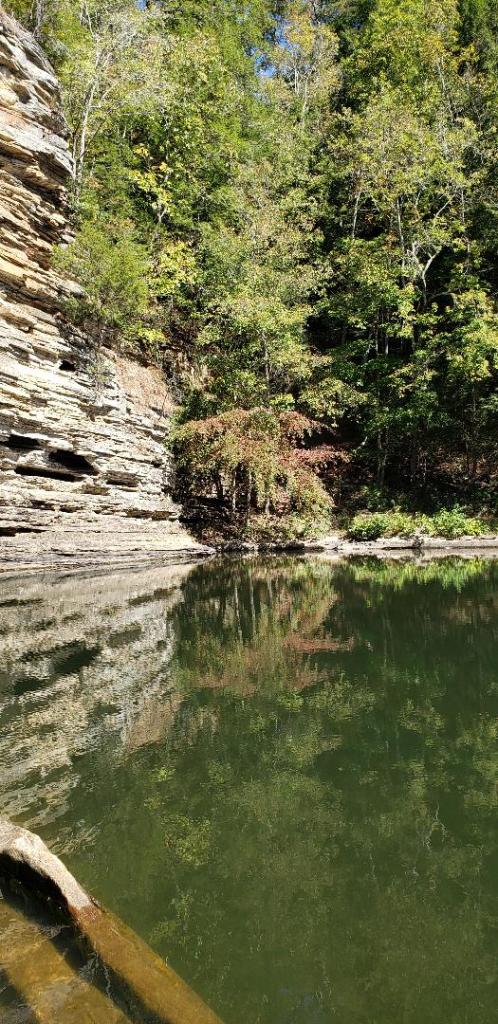
Fall Creek Falls State Park

We spent the next day exploring the park without ever wandering too far from the campgrounds since we had to keep driving back to see if the site we were moving to had been vacated. (Checkout time was at 1pm; the site was finally vacated somewhere between 2pm and 3pm.) The new site was a HUGE improvement over the first one and even had a sewage hookup. Once we got moved and set back up we continued our explorations and got to enjoy a beautiful sunset.

Fall Creek Falls State Park

Now that we had a great site, we were looking forward to the rest of our stay. Alas, it was not meant to be. Shortly before we settled in for the night I got blindsided by a stomach virus. It was a long, miserable night most of which I spent on the couch so my fever-induced tossing and turning wouldn’t bother Kenn. The next morning we decided just to pack it in and head home; I didn’t feel like doing anything and we were afraid that if we stayed, Kenn might come down with it about the time we were scheduled to leave. (Fortunately, he never did.)

All in all, Fall Creek Falls State Park is definitely worth a visit – as long as you avoid Campground C, LOL.

Until next time, happy trails!

Review: Stephen C. Foster State Park

If you love the great outdoors and are looking to get away from it all, you can’t do much better than Stephen C. Foster State Park. Stephen C. Foster State Park is located in the Okefenokee National Wildlife Refuge in southern Georgia and is one of the primary entrances to the Okefenokee Swamp. In my last post I told you that Amicalola Falls State Park is my favorite Georgia state park; Stephen C. Foster state park holds the honor of being my second favorite. The two parks couldn’t be more different.

American alligator at the park entrance

The park is home to many forms of wildlife not the least of which is the American alligator. The park offers guided boat tours of the swamp in addition to kayak and canoe rentals. We took a sunset boat tour during our first stay at the park in 2016 and it was wonderful – except for the yellow flies. (I had thirty bites on one foot/ankle and forty on the other. When they started itching, a week later, I thought I was going to lose my mind.) Unlike many of the other parks we have visited during the pandemic, Stephen C. Foster is continuing to offer both guided boat tours and canoe/kayak rentals; COVID restrictions have reduced the number of people allowed on each of the guided boat tours and all tours were booked during our recent stay.

During our 2016 visit we rented individual kayaks for a two-hour self-guided float in the swamp. This trip, we rented a tandem kayak which worked out well; the arthritis/rotator cuff issues in my shoulders would have prevented me from being able to paddle long on my own. Once again we enjoyed a two-hour self-guided float of a different section of the swamp. We saw several small and medium-sized gators sunning themselves on the banks and heard what we think was a wild hog. I love both the peace and quiet of the swamp and the desolate beauty.

Kayaking with my sweetie

When planning a stay at Stephen C. Foster, you’ll need to go prepared. The park is roughly twenty miles from the nearest town of Fargo, Georgia. Fargo is a tiny town; I think there is one restaurant in the town. In addition to being prepared to fix your own meals rather than eat out, you’ll also need to be prepared to have little to no cell signal. (Our satellite dish couldn’t pick up a signal due to all of the trees.) Stephen C. Foster is also an international dark sky park making it perfect for those who enjoy night photography.

While we were in the area we took a drive to check out Suwannee River State Park in Florida. Suwannee River is a beautiful small park that we have added to our list of places to visit. In addition to finding a new park to visit, this trip also gave me an idea for the perfect gift to give my hubby. Stay tune for details!

Oh, I almost forgot! I drove for an hour on the trip home. I’m slowly becoming less intimidated by this whole driving while towing gig. (Don’t expect me to be driving while towing through bit town/cities anytime soon though. There is still a limit to my bravery.)

Until next time, happy trails!

Review: Amicalola Falls State Park

Amicalola Falls State Park is located in the north Georgia mountains near Dawsonville; it is hands down my favorite Georgia state park. My family and I have gone to Amicalola many times over the years but our recent trip was only the second time we have camped. (For those not a fan of camping, the park also has a lodge and cabins.) Camping at Amicalola is not for the faint of heart; from the park entrance to the campground involves navigating a 25% grade. (Yes, you read that right.) As one of the park rangers once told us, this is where a lot of people discover that their tow vehicle isn’t up to the challenge.

The first time we camped at Amicalola we owned an RPOD 177 that we towed with our Toyota Highlander. The RPOD was near the top of the Highlander’s towing capacity but Bonnie (the Highlander) made it up the incline fine. It was the hairpin turn covered with loose gravel within the campground itself that really got my heart pumping. We made it (obviously) but we also drew a bit of an audience. (“Yeah, that gravel gives a lot of people trouble.”)

Our most recent trip was our first trip with Ruby as our tow vehicle. Ruby hauled our Flagstaff Micro Lite 21FBRS up the 25% incline like it was nothing. Even the ridiculously heavy fog wasn’t enough to stress us out with Ruby on the job. (Can you tell I like my big red truck? LOL.)

The view from the cab

The campground itself is relatively small with only 24 campsites and one bath house. However, it is laid out well and the road had been recently paved. There was also no gravel on the hairpin turn this time so it seems that someone finally devised a way to prevent that problem. Even though we arrived in rain and fog (not uncommon when we travel) it moved out overnight so we were able to get out and enjoy the rest of our trip. There are all sorts of things to see and do within the park itself, not the least of which is viewing the falls. Many of the activities and events have currently been curtailed due to COVID-19 so I recommend that you check the website (link at the beginning of this post) for the latest information before traveling.

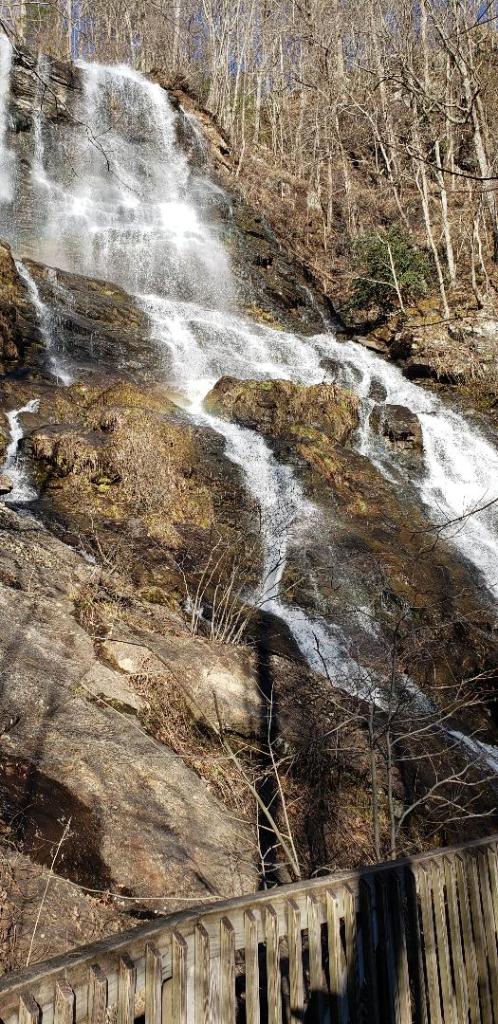
Amicalola Falls

It wouldn’t be a trip to Amicalola without viewing the falls so we did hike the stairs partway down the falls. The stairs at the falls are labeled as “Strenuous” and they are not kidding but there is also an accessible parking lot and trail which allows for viewing without the hike. We ventured out a little further this time and traveled down forestry service roads to reach the trailhead for Long Creek Falls. While the forestry service road itself was in less than stellar shape in some areas the ride was worth it for the winter wonderland of ice-covered trees we discovered at the top of a ridge. (You can see my favorite photo here.) The hike from the trailhead to the falls was approximately one mile and wasn’t strenuous at all. The falls were small but definitely worth the walk.

Long Creek Falls

Right now, I’m a happy girl. I’ve been struggling a bit with the continued self-isolation due to COVID and this was a much needed trip. My soul is always the most at peace in the mountains and being at my favorite park made it even better. *happy sigh*

Now I have to finish packing for our next adventure! Until next time, happy trails!

Achievement Unlocked: Towing

A couple of weeks ago I introduced you to Ruby, our new-to-us Toyota Tundra. We took Ruby on her first camping expedition last weekend; I’ll post about that next week. Even though we have owned a travel trailer since 2014, I have never driven while towing. Even though I know this puts a heavy burden on my husband, just the idea of driving while towing has always freaked me out and sent my anxiety level through the roof.

When we purchased my husband’s Toyota Tacoma in 2015 I wasn’t sure I would ever get used to driving it; it felt so much bigger than my Highlander. So, of course, I expected driving the Tundra (which is huge) be be an even bigger adjustment. However, much to my surprise, I actually love driving Ruby. I was apparently born to drive a big honkin’ truck. Who knew? So, on our trip home I decided I’d give towing a try and… I did it! I know that may seem like nothing to many of you but since traffic/driving is one of the biggest triggers for my anxieties, for me it’s a Really Big Deal and I’m proud of myself. I didn’t drive for long, only about twenty miles on a two-lane road between two small towns but now that I have done it once, I know I can do it again and for a longer stretch.

There’s no stopping me now, y’all!

Vintage style camper trailer and camping scene

The End of an Era

In January 2006 my husband and I traded in our Dodge Caravan on a 2005 Toyota Highlander. The Caravan had served us well while were were chauffeuring around growing teenage boys (two of our own and oodles of their friends). However, by 2006, most of those boys had their driver’s licenses and most of our chauffeuring days were behind us. We needed a vehicle big enough to haul the four of us when our boys were with us but not too big for just the two of us. After much research and several test drives of various vehicles we settled on the Highlander. Our choice turned out to be a good one. Our Highlander, named Bonnie, safely carried my husband on several work trips from Georgia to San Antonio and back not to mention our daily commutes to work, vacations, and the Great Road Trip of 2019. However, as of January 30, 2021, Bonnie has gone on to a new home with our daughter-in-law. Even though Bonnie is now fifteen years old and has a little over than 207,000 miles on her I have no doubt that with good routine maintenance she still has several years of life left in her.

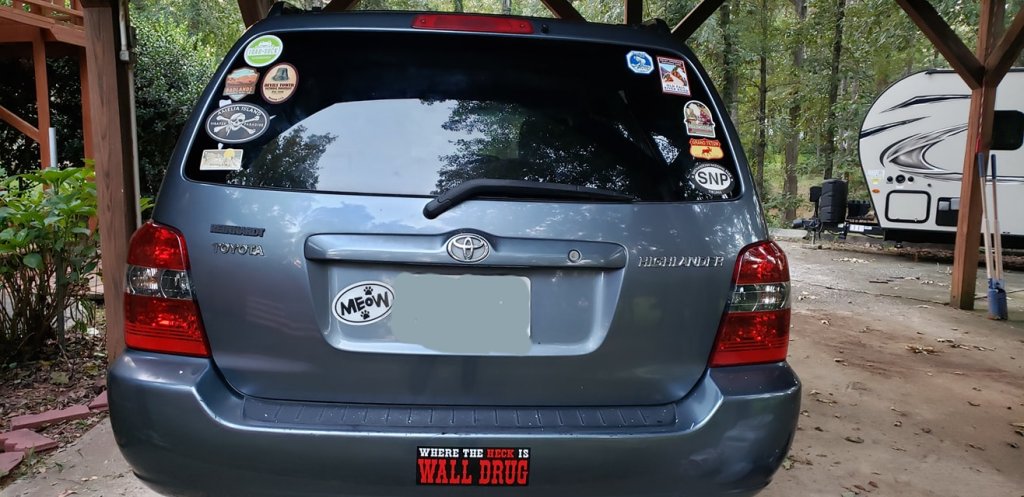
Bonnie, sporting her stickers from our various travels

Why has Bonnie gone to a new home? Well, as of January 26, 2021 we are what I swore we would never be – a two truck family. (I really need to stop using the word “never” – I think I’ve already done all of the things I swore I would never do.) We already had a Toyota Tacoma. My husband has owned many trucks over the years, most of which I hated. We bought his 2006 Tacoma used in 2015. It was such a relief to finally have a truck that I wasn’t afraid to ride in or drive. We were able to use the Tacoma to tow our RPOD 180 and its tow package is the only reason we were able to upgrade to our Flagstaff Micro Lite 21FBRS without purchasing a bigger tow vehicle.

So, if we could tow with our current truck why did we invest in a bigger truck now? My husband does the driving when we’re towing and I know that towing with his Tacoma makes him nervous, even knowing that we’re not even at the upper end of its tow capability. We have towed in mountainous areas and the Tacoma does fine, it just doesn’t have a lot of power to spare. Recently, I became aware that the Tacoma’s stopping capability while towing worried him. Our retirement plans included at least one road trip every year. The pandemic cancelled our planned trip for 2020 but we are planning to try again this Fall. (Hopefully we will be able to receive COVID vaccines by then.) So, we decided to go ahead and make the investment. Since our two Toyotas have been good to us, a Toyota Tundra was the next logical step for us. Researching trucks did nothing but reinforce this choice. So, we went for a test drive and came home with a new truck. Well, a new-to-us truck. Ruby the Big Red Truck is a 2018 model.

Meet Ruby, the big red truck

My husband has already taken the Tundra and the travel trailer out for a short drive so he could get the hitch configured properly. He came home very happy with the way the Ruby handled both while towing and stopping during the outing. Now I have two goals:

  1. Get used to driving a much larger vehicle.
  2. Start doing some of the driving when we’re towing the camper

Traffic/driving are two of the biggest triggers for my anxieties but I refuse to let my anxieties rule me so, I can do this. Right? Wish me luck!

Review: Hunting Island State Park

Hunting Island State Park is located on a barrier island fifteen miles east of Beaufort, South Carolina. My husband and I made a day trip to Hunting Island several years ago where we got to see two Clydesdales cavorting in the surf – definitely not something you see every day. 😉 When we were looking for somewhere different for a short getaway, we decided to give the Hunting Island campground a try.

Entering the campground is simple. Campers pull into the right-hand lane where a park employee comes to your car to complete the check-in process. Once the check-in process is complete things get a little more complicated. Hunting Island is an older park and the road that runs through it is very narrow in comparison to today’s vehicles and travel trailers so taking it slow and easy is a must. Even doing so, things got a little exciting when we reached an area where someone had parked on the left shoulder of the road and their bumper was sticking out a bit; a tree on the right side of the road meant we had zero wiggle room. Fortunately, we managed to squeak by without hitting either. We were in site 157 which is shown on the map as a pull-through. However, the only way to actually use it as a pull-through would have meant driving the wrong way down a one-way road. True, it would have only been a short distance but, still. We chose to back in. I liked the fact that the campsites weren’t crammed on top of each other. (I don’t like campgrounds where the sites are jammed one on top of the other.)

The beach is an easy walk from the campground and there is also a playground for the kiddos. My criteria for judging a beach are vastly different from those of most people. I’m a fair-skinned redhead who can sunburn in fifteen minutes without sunscreen, probably an hour with. I’m also a non-swimmer so I couldn’t care less about the surf, etc. The main things that interest me when at a beach are the size of the crowds and the fossils. Hunting Island beach wasn’t crowded at all but, it was October. As far as fossils went, we did find a few shark’s teeth over the course of our stay but not as many as we have found at other beaches. Oddly enough, most of the teeth were tiny as well. (According to the park website, Hunting Island is South Carolina’s most popular state park so it’s probably safe to assume that the beach will be much more crowded during the summer months.)

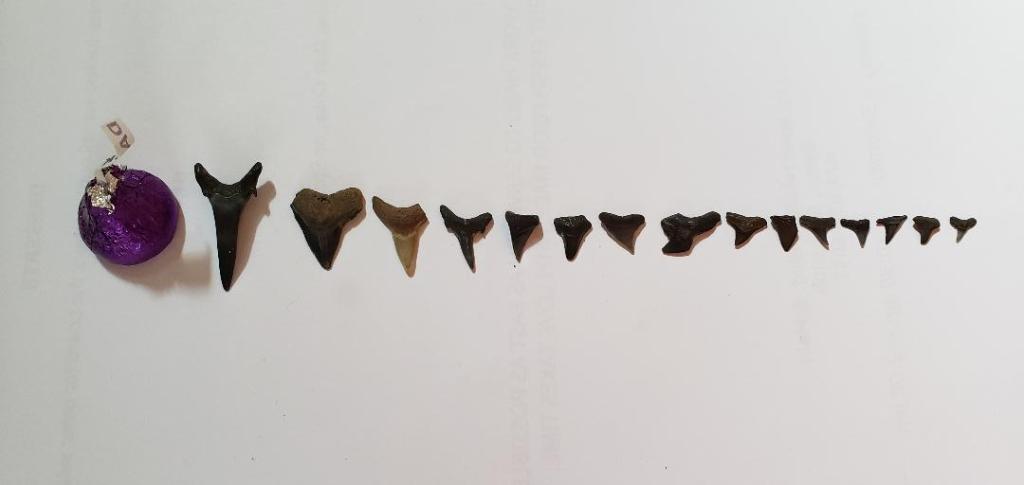
Shark’s teeth found on Hunting Island beach. Hershey’s kiss for scale.

The lighthouse on Hunting Island is the only one in the state that is accessible to the public. During our trip, coronavirus changes meant that visitors had to sign up for a specific time to climb the lighthouse. Not being a fan of heights or close quarters I was perfectly happy to take pictures with my feet firmly on the ground.

Hunting Island lighthouse

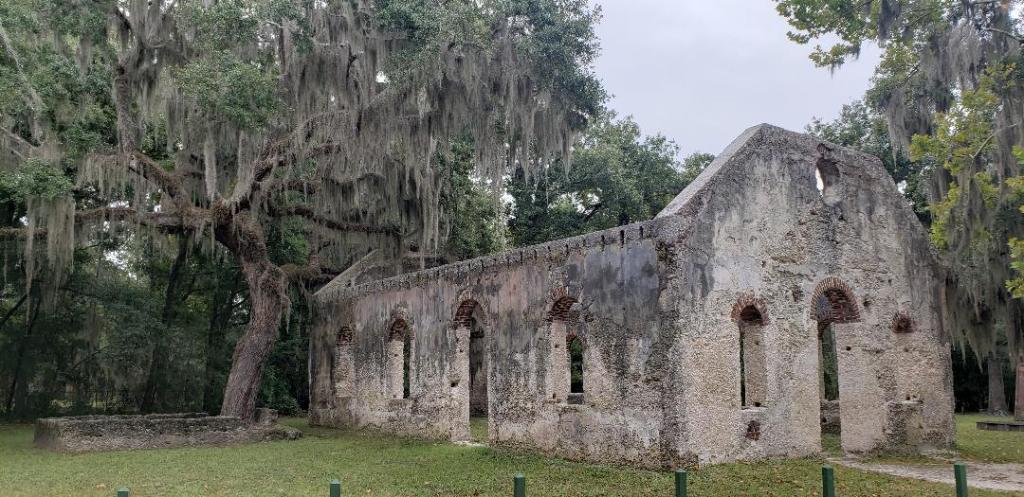
Our campground neighbor recommended we visit the St. Helena Chapel of Ease. If you are interested in ruins and history, the chapel is a short drive from the campground and is a good way to spend a little time. I find things like this fascinating; it amazes me that these tabby walls are almost 300 years old but are still standing.

St. Helena Chapel of Ease

All in all, Hunting Island State Park is not our favorite beach getaway; that honor belongs to Fort Clinch State Park on Amelia Island in Florida. However, if we have the urge to go to beach and can’t get into Fort Clinch (which is pretty much a given considering the difficulty of getting reservations there), Hunting Island isn’t a bad second choice.

Review: Moccasin Creek State Park

This is the first of the reviews I will post regarding the various campgrounds/parks we visit. I’m not going be rewarding a star rating or anything like that. I’m just going to post my thoughts on the park, pros/cons, etc.

Moccasin Creek State Park is located in the mountains of Rabun county in north Georgia. The park is bordered on three sides by Hwy 197 and on the fourth by Lake Burton. First impressions are important and, when we entered the park, my first thought was “Wow. This place is small. I don’t like it.” The website lists the size of the park as 32 acres; I’m not sure what is included in that acreage but the actual area for campsites is nowhere near that large. Even so, the park features 53 campsites.

Small “falls” on the stream in the park

One of the most important things to me when camping is the layout of the campsites. Are they shaded? (Shade is an important consideration here in the South – especially in the summer.) Are they on top of each other or is there a little space in between sites? Our campsite was on the outer loop for which I was thankful. I don’t like feeling crowded, especially when camping. If we had been in the inner section, I would have probably been ready to leave the next day. Being on the outer loop meant that our campsite backed up to the road but that wasn’t a problem; Hwy 197 is a two lane “country” road and is hardly a beehive of activity.

In spite of my initial dislike of the park, it grew on me a little over our visit. Moccasin Creek is a really pretty park. A small stream flows down one side of the park and there are swings and benches scattered around where you can sit and commune with nature. Normally, it would have been possible to rent a kayak, canoe, or paddleboard; however, this is 2020 and rentals were not available due to COVID restrictions. Fortunately, no special equipment is needed to view Hemlock Falls and it’s an easy hike from the park.

Hemlock Falls

If you get twitchy without easy access to cell service at all times, brace yourselves. Verizon is our service provider and our signal strength was virtually non-existent at the park. However, there are a few towns within easy driving distance where signal strength is better.

Overall, while pretty enough, Moccasin Creek is not a park we plan to revisit.

Have you been to Moccasin Creek? If so, what did you think?

The Great Road Trip of 2019

Last year my husband and I began what we hope to make a yearly tradition – a road trip to visit parts of the country we have yet to see. It was also supposed to be our first long-term trip with our camper but that changed due to concerns over rising gas prices. (My husband’s truck only gets 8-9 mpg when towing so that’s always something to take into consideration.) Our ultimate destination was Glacier National Park. It was when we began researching and mapping out our route that we realized we were thinking like Southerners.

What do I mean by “thinking like a Southerner”? We initially planned our trip to coincide with Memorial Day weekend to reduce the number of vacation days my husband would need to take. (I had retired at the end of April.) However, when I began doing some research on Glacier I discovered that the Going To The Sun road through the park may not open until late June/early July depending on the amount of snow to be cleared. Snow? In July? As a life-long native of the South the thought of snow on the ground in July is unfathomable. Heck, we barely get snow in January and February. But, with that useful tidbit in mind, we rescheduled our trip for July.

Honestly, I’m glad we decided against taking the camper. We travel slower when towing so we wouldn’t have been able to see as much as we did if we had. Not to mention the fact that towing a camper through some of the mountain ranges we traveled would have probably made me hyperventilate. So, instead of taking my husband’s Toyota Tacoma, we made the trip in my then 14-year-old Toyota Highlander in order to take advantage of the better mileage.

Bonnie, my Highlander, got stickers to commemorate our trip

Was it a good trip? Absolutely. Did we learn a few things to implement in future trips? Definitely. In 17 days we covered 6048.5 miles, 13 states, and 6 national parks/monuments.

States visited:

Alabama
Mississippi
Tennessee
Arkansas
Kansas
Oklahoma
Iowa
Missouri
South Dakota
Wyoming
Montana
Idaho
Colorado

National Parks/Monuments visited:

Badlands
Mount Rushmore
Devil’s Tower
Glacier
Yellowstone
Grand Tetons

I’ll go into more detail regarding lessons learned in a later post but the biggest lesson we learned was to build more downtime into our schedule. We kept to a pretty grueling pace and only had a couple of days where we didn’t have anything planned. As enjoyable as the trip was, we were exhausted by the time we got home.

Do you have any road trip tips?

The Evolution of a Couple’s Camper – Part 3

I meant to post this earlier but I got lazy after our summer road trip. What can I say? The fact that this series even has a Part 3 is evidence that my husband and I cannot be trusted to simply “look” at travel trailers.

We had Gypsy, our RPOD 180, and everything was fine. There was only one minor inconvenience we felt might need to be addressed in a few years. Like many smaller travel trailers both our RPOD 177 and the 180 had east/west beds meaning that the head of the bed touched one wall, the foot the other, and the third side pressed against the front wall of the camper. This caused two problems: First, if the person sleeping on the inside (me) had to get up in the middle of the night I either had to crawl over my husband sleeping peacefully on the outside or wake him up, neither of which were ideal situations. Second, making the bed in a small travel trailer with an east/west oriented mattress is nothing short of an Olympic event. We discussed the eventual need to upgrade to a travel trailer with a north/south bed as we aged; a north/south bed would allow access from both sides, negating the whole crawling over/waking up scenario. But, I assumed that decision was still several years away. Silly me.

One day my husband announced that he had been looking online at campers with a north/south bed and had found one he thought we should check out: a Flagstaff Micro Lite 21FBRS. (The Rockwood Mini Lite equivalent is the 2109s. Rockwoods and Flagstaffs are manufactured at the same plant. The 2109s and 21FBRS floorplans are identical; only the decals and fabrics are different.) One of the local RV dealers had a couple in stock so, we stopped by to take a look and the rest is history.

The 21FBRS had everything we had talked about wanting in our future travel trailer and more. Instead of a dinette it has a love seat with a free-standing table that stores when not in use freeing up valuable floor space. The table can also be used outside. (Removing the dinette and replacing it with a loveseat/freestanding table is one of the frequent modifications made by RPOD owners.) It had the north/south bed described above, the shower has an actual sliding door instead of a shower curtain, a full-sized RV refrigerator/freezer (instead of the college dorm sized unit in our RPOD), a three-burner stove, an oven, a microwave, a double-sink and more storage than we ever dreamed possible.

Image from http://www.campersinn.com

When we made the move from our RPOD 177 to our 180, we didn’t do the sort of due diligence we should have. We only looked at the 180 before making our purchase. We were determined to not make the same “mistake” again. This time we spent a ridiculous amount of time researching a variety of travel trailers by a number of manufacturers and traveled to several different dealers (one in another state) to make absolutely sure we would be getting everything we wanted. The only model other than the 21FBRS that we considered was the Flagstaff 21DS. I loved this model. It had a U-shaped dinette where I could spread out with my laptop while my hubby lounged on the loveseat. (The bed is a murphy bed.) As much as I loved the 21DS, it had a few significant drawbacks. First, due to the murphy bed it was heavier than the 21FBRS and it didn’t have the pass-through meaning the loss of a lot of exterior storage. There was also less interior storage. However, the deciding factor was that, with the slide in, the 21DS is not a functional camper, the 21FBRS is. With the slide in, the bed, loveseat, and bathroom in the 21FBRS are still accessible, a definite plus when traveling.

In spite of all of the research, and as much as we loved the 21FBRS we didn’t think we would be able to make the move simply because of the weight – we didn’t want to have to upgrade to a larger tow vehicle. Then, we discovered that my husband’s 2006 Toyota Tacoma (bought used in 2015) came with a tow package capable of hauling over 6000 pounds, a good 2000 more than needed. So, earlier this year we sold our RPOD 180 and purchased a new Flagstaff 21FBRS which we named Serenity after the ship in the short-lived sci-fi series Firefly.

We both love Serenity but it has been a big adjustment. Towing a larger (22 foot), heavier trailer has been a little nerve-wracking for both of us. (My hat is off to those of you who tow fifth wheels around like it’s no big deal. You have my utmost respect.) However, after a recent trip to the mountains and a few steep, winding roads we now know beyond the shadow of a doubt that Paco (the Tacoma) is more than up to the task. We also had to invest in new mirrors for the truck in order to be able to see around the wider camper.

We’re looking forward to many years of adventure with this travel trailer – and I’ve told my husband he’s not allowed to look at any more. We obviously have no willpower and I don’t want to go through this process again anytime soon. It’s exhausting, LOL!